

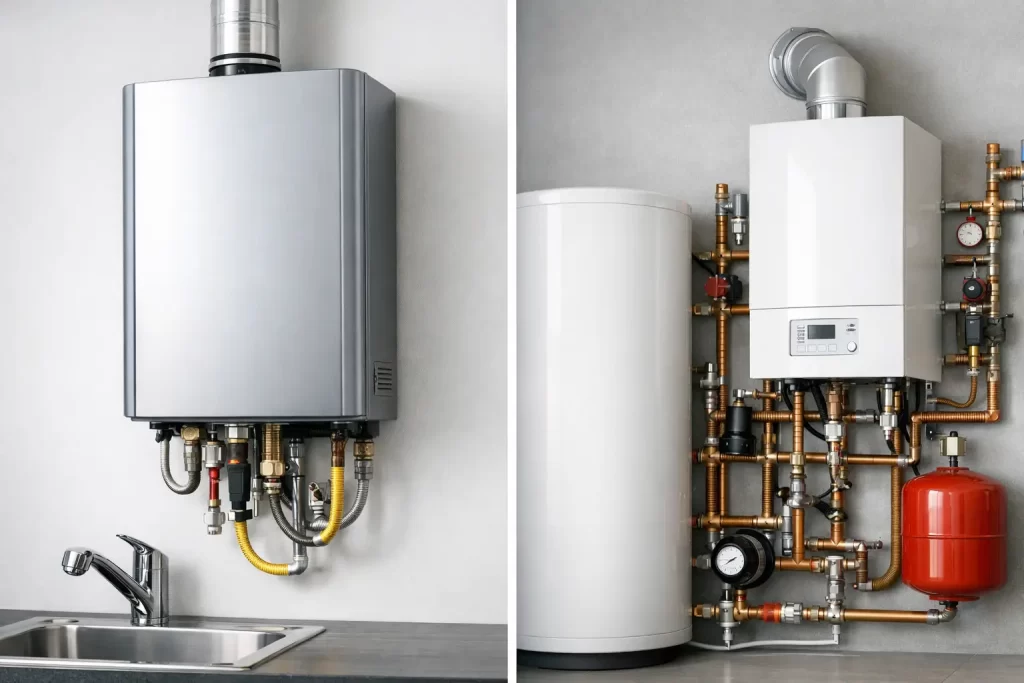
If your old hot water system is failing, the question usually comes fast: tankless water heater vs boiler. Homeowners often use those terms like they mean the same thing, but they do very different jobs. Choosing the wrong one can leave you with high install costs, uneven comfort, or a system that does not match how your home actually uses hot water.
A tankless water heater is built to provide domestic hot water on demand for showers, sinks, laundry, and dishwashing. A boiler heats water for space heating, usually through baseboards, radiators, radiant floors, or in some cases an indirect water heater. Some boilers can also help produce domestic hot water, but that is not their primary role unless the system is designed for it.
Tankless water heater vs boiler: the core difference
The simplest way to look at tankless water heater vs boiler is this: one is mainly for hot tap water, and the other is mainly for heating your home. That distinction matters because the equipment size, piping layout, venting, fuel use, and maintenance needs are all different.
A tankless unit turns on when you open a hot water fixture. It heats water as it passes through the system, so there is no large storage tank sitting full of hot water all day. That can improve energy efficiency, especially in homes that want to avoid standby heat loss.
A boiler heats water and circulates it through a closed-loop heating system. It is designed around comfort heating, not just kitchen and bathroom demand. In colder Massachusetts winters, that role becomes a major part of the conversation because heating performance matters just as much as utility savings.
When a tankless water heater makes more sense
If your main concern is replacing a standard water heater and improving hot water efficiency, a tankless system may be the better fit. It is often a strong option for homes that need reliable hot water without dedicating space to a bulky storage tank.
One of the biggest advantages is on-demand operation. You are not paying to keep 40 or 50 gallons hot around the clock. For many households, that means lower energy use over time. Tankless units also take up less space, which can be helpful in tight utility rooms, basements, or smaller homes.
They can also provide a long service life when properly installed and maintained. That said, performance depends heavily on sizing. A tankless unit that is too small may struggle if two showers, a dishwasher, and a washing machine are running at the same time. That is why flow rate matters more than people expect.
In areas with hard water or mineral buildup, routine flushing is also important. Without maintenance, efficiency can drop and parts can wear out faster. For many homeowners, the technology is a good match, but it is not a set-it-and-forget-it system.
When a boiler is the better investment
A boiler makes sense when your home already uses hydronic heat or when you are planning a heating system upgrade built around hot water distribution. If you have baseboard heat, cast iron radiators, or radiant floor heating, a boiler is usually the central piece of that system.
The main benefit is comfort. Boilers tend to deliver even, steady heat that many homeowners prefer over forced air. They are especially effective in colder climates where reliable whole-home heating is a priority for long stretches of the year.
Boilers can also be highly efficient, especially newer high-efficiency models. But the install cost is typically higher than a straightforward water heater replacement because the system is doing more. It may involve circulator pumps, zoning controls, expansion tanks, indirect tanks, and more complex piping.
If your home needs space heating and domestic hot water, a boiler can sometimes handle both with the right setup. An indirect water heater paired with a boiler is a common example. This approach can work very well, but it is usually a more involved design decision than swapping in a tankless unit.
Cost is not just about the equipment
Homeowners often compare sticker prices and stop there. That usually leads to bad assumptions.
A tankless water heater may cost less than installing a full boiler system, but the final number depends on gas line sizing, venting upgrades, electrical work, plumbing changes, and code requirements. In some homes, a tankless swap is simple. In others, it requires significant modifications to support the unit safely and correctly.
A boiler installation is generally more expensive because it supports a larger heating function, not just hot water delivery. But if your home already runs on a boiler system, replacing an aging boiler may be the smartest long-term move. Trying to force a tankless unit into a role it is not designed for can create more problems than savings.
Operating costs depend on the fuel source, system efficiency, insulation, fixture demand, and how your home is heated. A high-efficiency system of either type can perform well, but only if it is matched to the property.
Efficiency depends on how your home uses hot water and heat
Tankless systems are often marketed as the efficiency winner, and in many hot-water-only applications, that is fair. They avoid standby losses and can be very efficient for households with moderate to high hot water use patterns spread throughout the day.
But if your home relies on hydronic heat, a boiler is serving a completely different purpose. Comparing a tankless water heater to a boiler on efficiency alone is not always apples to apples. A boiler may be the more efficient choice for heating your home because it is built specifically for that load.
This is especially true in places like Cape Cod, where weather swings and heating needs can put real stress on underperforming systems. The right answer is usually the one that handles your actual usage pattern with the fewest compromises.
Installation and space considerations
Tankless units are compact, wall-mounted, and appealing when floor space is limited. For homeowners finishing a basement or cleaning up a mechanical room, that smaller footprint can be a real advantage.
Boilers need more planning space, especially if the setup includes multiple zones or an indirect tank. They are not always oversized, but the overall system is usually more involved. Access for service, venting layout, and piping design all matter.
This is one reason professional evaluation matters. Two homes with the same square footage can need very different solutions based on fixture demand, existing heat distribution, fuel availability, and the age of the plumbing or heating infrastructure.
Maintenance and repair expectations
Neither system should be installed and ignored.
Tankless water heaters need periodic descaling or flushing, burner checks, and inspection of venting and controls. In areas with mineral-heavy water, skipping maintenance can shorten equipment life and affect performance.
Boilers need annual service too. That can include checking pressure, inspecting expansion components, verifying safe combustion, testing controls, and making sure circulators and zones are working properly. Because boilers are tied directly to home heating, delayed repairs can become urgent quickly when temperatures drop.
For property owners, the practical question is not which system needs zero service. It is which system best fits the job so maintenance stays predictable instead of turning into emergency calls.
Which one is right for your home?
If you need domestic hot water only, a tankless water heater is often the right conversation to have. If you need dependable whole-home heat through radiators, baseboards, or radiant flooring, you are likely in boiler territory.
There is also a middle ground. Some homes benefit from a boiler with an indirect water heater. Others do better with a separate heating system and a dedicated tankless unit for domestic hot water. The right answer depends on the age of the home, the fuel source, the number of bathrooms, the heating system already in place, and how much hot water your household uses during peak times.
That is why the best decision usually starts with a load calculation and an honest look at your property, not a generic online comparison chart. A family home with two full baths in Barnstable does not have the same demand profile as a small seasonal property in Provincetown or a mixed-use building in Plymouth.
If you are weighing comfort, operating cost, and installation complexity, the clearest path is to match the equipment to the job instead of chasing whichever option sounds newer or cheaper. A good system should fit your home, your daily routine, and your winter heating needs without creating new headaches. That is the kind of decision that pays off long after installation day.