

If your house has hot second-floor bedrooms, stuffy additions, or rooms that never seem to cool evenly, the question of ductless mini split vs central air gets real fast. On Cape Cod, where some homes have existing ductwork and others were never built for it, the right answer often comes down to layout, budget, and how you actually use each room.
Ductless mini split vs central air: what is the difference?
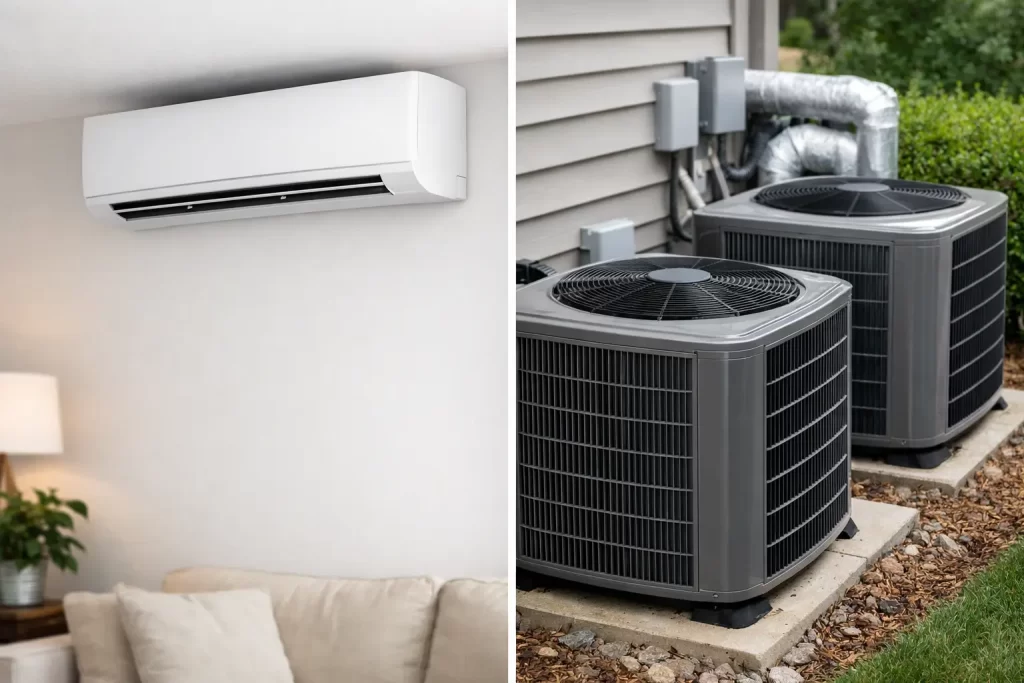
A central air system cools the whole home through a network of ducts. One indoor air handler or furnace works with an outdoor condenser, and conditioned air is delivered through supply vents in each room. When the duct system is well designed and in good condition, central air can provide consistent whole-home cooling with a familiar thermostat setup.
A ductless mini split uses one outdoor unit connected to one or more indoor air handlers mounted in specific rooms or zones. Instead of pushing air through ductwork, each indoor unit conditions the space where it is installed. That gives you room-by-room control, which is a major reason homeowners choose mini splits for additions, older homes, and areas with uneven temperatures.
The basic difference is simple. Central air is built around one connected air distribution system. Ductless is built around targeted zones.
Which system is better for your home?
There is no universal winner in ductless mini split vs central air. The better system depends on the house.
If your home already has ducts in good shape, central air can be the more practical option for whole-home cooling. You are using infrastructure that is already there, which can reduce installation complexity. It also keeps the look of the home unchanged except for vents and the outdoor unit.
If your home does not have ductwork, central air becomes a bigger project. Adding ducts can mean opening walls or ceilings, working around attic or crawlspace limitations, and solving airflow challenges in older floor plans. In that situation, ductless often becomes the cleaner and more cost-effective path.
Mini splits also make sense when only part of the property needs help. Maybe the upstairs runs hot, the family room addition never matched the rest of the house, or a finished basement needs separate cooling. Installing a full central system for one problem area may be more system than you need.
For many Cape Cod homes, age and layout matter as much as square footage. A compact ranch with decent ducts has different needs than a historic home or a multi-level house with hard-to-reach spaces.
Installation cost and project scope
Cost is where a lot of decisions get made, but it helps to think beyond equipment price.
Central air may look straightforward if ducts already exist and can support the new system. If not, the price can rise quickly because duct installation is labor intensive. The final cost depends on home size, number of rooms, accessibility, insulation, and whether the existing heating system can work with the new cooling equipment.
Ductless mini splits usually avoid the expense of full duct installation. That can make them attractive for retrofits. Still, the number of indoor heads matters. A single-zone system for one room is very different from a multi-zone setup covering most of the house. As more indoor units are added, the equipment and labor costs increase.
In other words, central air can be more economical in homes that are already set up for it. Ductless can be more economical where ducts would have to be built from scratch. The lowest number on a quote does not always mean the better long-term value, especially if one option leaves comfort issues unresolved.
Energy efficiency and operating costs
Ductless systems are often known for efficiency, and that reputation is deserved in many situations. Because they do not rely on ducts, they avoid energy losses that happen when ductwork leaks or runs through hot attics and unconditioned spaces. They also let you cool only the rooms you are using.
That zoning advantage can lower operating costs, especially in homes where certain rooms sit empty for much of the day. If you only need to cool bedrooms at night and a home office during the day, a mini split gives you that flexibility.
Central air can still be efficient, especially in a tighter home with properly sealed and insulated ducts. If the system is correctly sized and the airflow is balanced, central air can deliver strong performance across the whole house. The problem is that many existing duct systems are not in ideal condition. Leaks, poor design, and restricted returns can all reduce efficiency.
So when comparing ductless mini split vs central air, efficiency is not just about the equipment rating. It is also about the condition of the house and the distribution system supporting it.
Comfort and temperature control
Comfort is where the difference becomes obvious in daily use.
Central air is designed to maintain a uniform temperature across the home. For families who want one main thermostat and a familiar whole-house setup, that simplicity has value. In a well-designed system, every room should stay reasonably close to the target temperature.
Mini splits take a more customized approach. Each zone can be adjusted independently, which helps when family members prefer different temperatures or when some parts of the home heat up faster than others. A sunny upstairs bedroom can be set differently from a shaded first-floor den.
The trade-off is that ductless comfort is more localized. That is great for targeted control, but if you want every room cooled in the same way at the same time, central air may feel more straightforward.
Humidity matters too, especially in coastal areas. Both systems can help with indoor comfort, but performance depends on sizing and installation quality. An oversized system of either type can short cycle and remove less humidity than it should, leaving the home cool but clammy.
Appearance, noise, and day-to-day experience
Some homeowners prefer central air because most of the system stays hidden. You see registers and maybe a thermostat, but not the air handler itself in each room. That cleaner look can matter in living rooms, kitchens, and primary bedrooms.
Ductless systems require visible indoor units. Many people stop noticing them after a while, but others never love the appearance. That is a fair consideration, especially if interior design is a priority.
On the other hand, mini splits are typically quiet, and the room-by-room control is convenient. Central air can also be quiet when installed properly, but noise can travel through ductwork if the system is oversized or airflow is poorly managed.
Maintenance and long-term service
Both systems need regular maintenance. Filters need attention, coils need cleaning, and refrigerant levels and electrical components should be checked by a licensed technician.
With central air, duct condition becomes part of the long-term picture. Dirty, leaking, or damaged ducts can affect airflow, efficiency, and indoor air quality. With ductless, each indoor head needs to be cleaned and maintained, so a multi-zone setup can mean more individual components to service.
Reliability comes down to installation quality as much as brand name. Proper sizing, refrigerant charge, airflow setup, and controls all matter. A good system on paper can still underperform if it is installed poorly.
When ductless makes more sense
Ductless is often the better fit when the home has no ducts, when you are cooling an addition or converted space, or when certain rooms need separate temperature control. It is also a smart option if tearing into walls and ceilings for new ductwork would be expensive or disruptive.
Property owners often like mini splits in spaces with uneven occupancy. A guest suite, office, retail area, or workshop does not always need the same cooling schedule as the rest of the building.
When central air makes more sense
Central air usually makes more sense when the property already has usable ductwork and you want one system to cool the entire home evenly. It also appeals to homeowners who prefer a less visible setup and a familiar thermostat-based experience.
For larger homes where every room is occupied regularly, central air can feel simpler to manage. One well-designed system may be easier than coordinating multiple indoor zones.
The best choice starts with the house, not the sales pitch
The real answer to ductless mini split vs central air comes from evaluating the structure itself. Existing ducts, insulation levels, room usage, sun exposure, ceiling height, and budget all shape the right recommendation. A quick rule of thumb can point you in the right direction, but it should not replace a proper assessment.
If you are weighing options for a home in Barnstable, Hyannis, Falmouth, or anywhere across Cape Cod, focus on the system that solves your actual comfort problem without creating unnecessary installation cost. The best HVAC choice is the one that fits the building, keeps operating costs reasonable, and holds up over time. A clear estimate from a licensed local professional will tell you more than any generic online comparison ever will.