

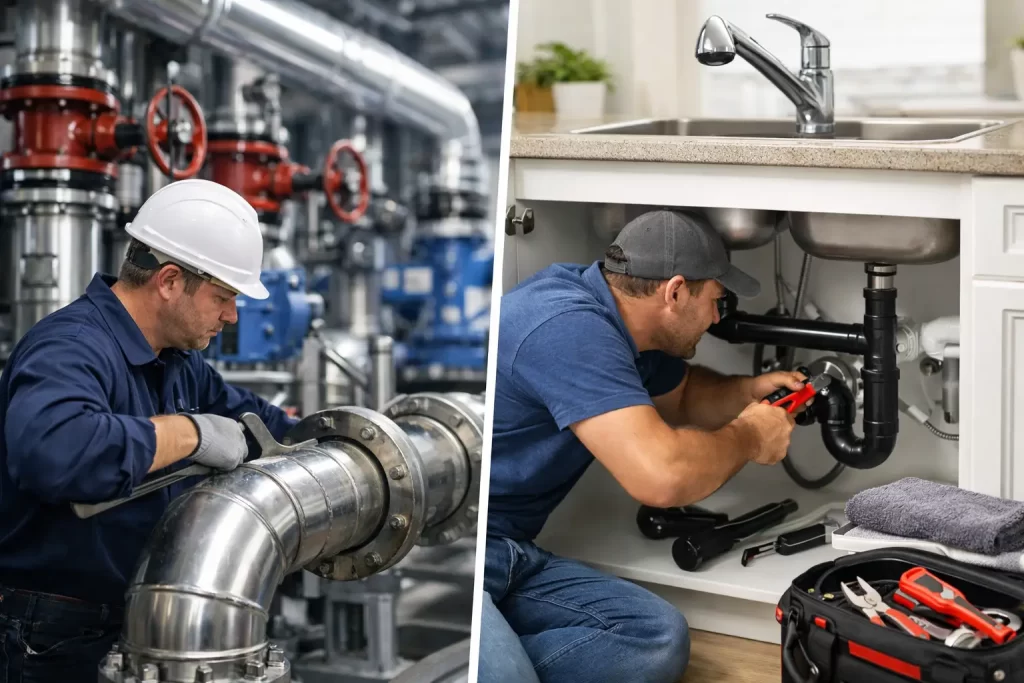
A restaurant with one backed-up drain can lose a full day of business. A home with the same issue is stressful, but the impact is usually contained to one family. That difference gets to the heart of commercial plumbing versus residential plumbing – both move water and waste, but the systems, stakes, and service demands are not the same.
If you own a home, manage a rental, or oversee a commercial property, understanding that distinction helps you make better decisions. It affects the type of equipment you need, the kind of maintenance schedule that makes sense, how repairs are handled, and why one plumbing job may cost or take more than another.
Commercial plumbing versus residential plumbing: the core difference
Residential plumbing is built around daily living for a household. Think kitchens, bathrooms, laundry, water heaters, and the fixtures most families use every day. The system is usually smaller, easier to access, and designed for predictable patterns of use.
Commercial plumbing serves larger buildings and more people, often at the same time. Offices, restaurants, retail spaces, apartment buildings, medical facilities, and mixed-use properties all put more demand on pipes, drains, water lines, and sewer systems. That means the plumbing has to handle higher volume, more frequent use, and stricter code requirements.
At a glance, the difference may seem like scale alone. In practice, it is also about complexity. Commercial systems often include more fixtures, larger pipe sizes, specialized equipment, multiple floors, public restrooms, grease traps, backflow prevention assemblies, and tighter compliance standards. Residential systems are generally more straightforward, even when they involve major repairs or upgrades.
Why plumbing design changes so much by property type
In a home, plumbing is usually laid out for convenience and comfort. A kitchen sink, two or three bathrooms, a washing machine, and a water heater create a manageable system. The design focuses on reliable performance, reasonable efficiency, and service access when a repair is needed.
In commercial buildings, plumbing design has to account for occupancy, building use, health regulations, and peak demand. A restaurant may need to handle heavy grease, constant dishwashing, employee restroom use, and customer traffic. An office may need dependable restroom performance across multiple floors. A multifamily property may blur the line between residential and commercial because each unit functions like a home, but the building infrastructure behaves more like a commercial system.
That is why commercial work often requires more planning up front. Pipe routing, water pressure, drain slope, fixture count, and equipment sizing all carry more consequences when dozens or hundreds of people depend on the system.
Fixture count, usage, and wear are not even close
One of the biggest differences in commercial plumbing versus residential plumbing is how hard the system works.
A residential toilet, faucet, or water heater sees regular use, but usually within a predictable daily cycle. In a commercial setting, fixtures may run almost nonstop. Public restrooms are used by many people with very different habits. Break rooms, mop sinks, service sinks, and utility areas add more wear. In restaurants and some service businesses, drains and supply lines are under constant pressure during operating hours.
That repeated use changes everything. Parts wear out faster. Small issues become bigger sooner. A slow drain in a house might be an inconvenience for a week or two. In a commercial property, that same problem can turn into sanitation concerns, customer complaints, or business interruption very quickly.
Codes, inspections, and compliance matter more in commercial work
Both residential and commercial plumbing have to meet code. The difference is that commercial work usually has more layers of oversight and less room for error.
Commercial buildings may need specific backflow prevention, ADA-compliant fixture placement, larger venting systems, grease management, and documented inspection schedules. Certain property types also face industry-specific rules. Food service, healthcare, and lodging can all come with additional plumbing expectations tied to public health and safety.
For property owners, this means commercial plumbing is not just about fixing leaks. It is also about protecting the building from failed inspections, liability issues, and avoidable shutdowns. Residential code compliance is still important, especially during remodels or system replacement, but commercial properties typically carry more operational risk when plumbing work is not done correctly.
Access and repair conditions are very different
A repair under a kitchen sink in a house is usually straightforward to diagnose and reach. A leak in a commercial building may be above a drop ceiling, behind finished walls, under a slab, inside a mechanical room, or affecting multiple tenant spaces at once.
That access challenge often changes labor time and repair strategy. In homes, plumbers can often isolate the issue quickly and restore service with minimal disruption. In commercial settings, repairs may need to be scheduled around business hours, tenant activity, health requirements, or occupancy demands. Sometimes a simple repair is not simple at all because shutting down part of the system affects customers, employees, or multiple units.
This is one reason response speed matters so much for commercial service. A fast diagnosis can limit damage, reduce downtime, and keep a plumbing issue from spreading into a larger operational problem.
Commercial equipment is often more specialized
Most homeowners are familiar with standard plumbing fixtures and equipment – toilets, sinks, showers, water heaters, hose bibs, sump pumps, and garbage disposals. Commercial properties may include those basics, but they often add more specialized systems.
Depending on the building, that can mean commercial-grade water heaters, booster pumps, grease interceptors, flushometer valves, backflow devices, larger shutoff systems, and heavy-duty drain infrastructure. These components are built for volume and durability, but they also require the right training to install and service properly.
That does not mean residential work is simple. Tankless water heater installation, repiping, sewer line repair, and gas line work all require skill and experience. The difference is that commercial systems more often involve broader coordination between plumbing, heating, mechanical systems, property management, and code enforcement.
Maintenance matters more in commercial properties
Many homeowners call a plumber when something goes wrong. That approach is common, and in some cases it is enough. In commercial buildings, reactive service alone usually costs more in the long run.
Routine maintenance is a much bigger part of commercial plumbing because the cost of disruption is higher. A scheduled drain cleaning may prevent an emergency backup. An inspection of water heaters, shutoff valves, and backflow assemblies may catch an issue before it affects tenants or customers. Preventive maintenance is not just about avoiding repair bills. It is about reducing downtime and keeping the property usable.
For Cape Cod businesses and property managers, seasonal demands can make this even more important. Busy tourist periods can put heavy pressure on restrooms, kitchens, and water systems. Winter conditions bring another layer of risk, especially in seasonal or partially occupied properties where freeze protection and winterization need attention.
Cost differences come down to more than size
People often assume commercial plumbing costs more simply because the pipes are bigger or the building is larger. Sometimes that is true, but cost is really shaped by complexity, access, code requirements, fixture count, and urgency.
A residential project can still be expensive if it involves hidden leaks, water damage, repiping, or sewer replacement. A commercial repair can be relatively contained if the issue is isolated and easy to access. The better way to think about cost is this: commercial jobs usually have more variables, and those variables tend to carry higher consequences.
There is also the cost of delay. In a home, postponing a repair may lead to inconvenience or property damage. In a business, it may also mean lost revenue, tenant complaints, failed inspections, or temporary closure. That is why the cheapest option is not always the best value.
Which type of plumber do you need?
Not every plumber handles the same kind of work every day. Some focus mainly on homes. Others are equipped for larger commercial systems, emergency response, and more technical installations.
If you are a homeowner, you want a licensed plumber who can handle the practical issues that come up most often – leaks, clogged drains, water heaters, frozen pipes, fixture replacement, and system upgrades. If you manage a business or mixed-use property, you need a company that understands commercial demands, can work efficiently under pressure, and can help you think beyond the immediate fix.
That matters even more when a property has both residential-style fixtures and commercial infrastructure. Multifamily buildings, restaurants with attached living quarters, and mixed-use spaces often require both mindsets.
How to think about the right solution
The best plumbing decision depends on how the building is used, how much downtime you can tolerate, and whether the issue is isolated or part of a larger pattern.
If the same drain keeps clogging, the answer may not be another quick clearing. If water pressure problems affect multiple fixtures, the issue may be in system design, not just a single valve. If a commercial water heater is struggling during peak hours, replacement may be smarter than repeated repair. Good plumbing service is not just technical work. It is matching the repair or upgrade to the way the property actually operates.
That is where experience makes a difference. A service company that works in both homes and commercial buildings can often spot the practical trade-offs faster and recommend a fix that fits the property, the timeline, and the budget.
Whether you are dealing with a house in Barnstable, a rental in Falmouth, or a business that cannot afford a day of downtime, the real question is not which type of plumbing is harder. It is which approach keeps your property safe, functional, and ready for the people who depend on it.